Q&A: Allison Kerska is preparing to lead Fishers-based life sciences firm into new era
October 2, 2026 | Daniel Bradley
Originally published in the Indianapolis Business Journal
Allison Kerska knows the importance of rowing together.
As a student at the University of Michigan, Kerska performed on the crew team where one person not following the leader’s pace threw off the balance of the group. It’s an important lesson that stuck with Kerska in the professional world.
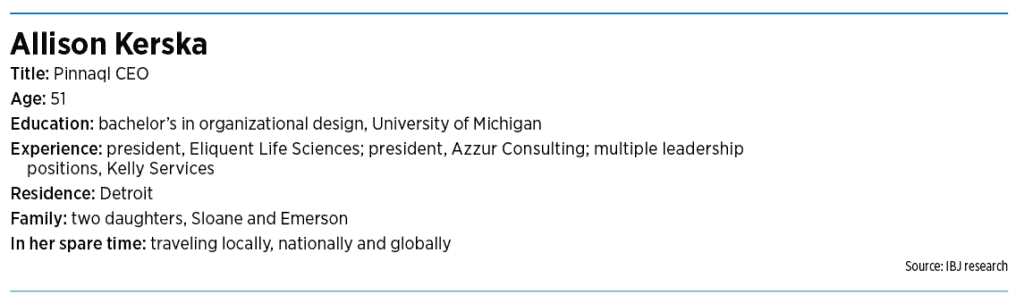
Last month, Kerska was named CEO of Fishers-based Pinnaql, which provides technical, engineering and regulatory compliance consulting for pharmaceutical, biotechnology and medical device manufacturers.
Kerska succeeded former CEO John Duffin, who led Pinnaql through a period of growth. Duffin is now the company’s chief strategy and corporate development officer. Currently, Pinnaql has 200 engineers, scientists and quality professionals who work at offices in Fishers, Philadelphia, Atlanta and San Juan, Puerto Rico.
Kerska lives in Detroit but will be traveling frequently to Indiana. She most recently served as president of Washington, D.C.-based Eliquent Life Sciences and spent more than a decade in leadership roles with Troy, Michigan-based Kelly Services.
She sat down with IBJ to talk about Pinnaql, the evolution of life sciences in the U.S. and her experience training dogs before they are placed with blind clients.
This conversation has been edited for length and clarity.
For people who aren’t familiar with Pinnaql, what does the company do?
Pinnaql is a life sciences consulting firm, and we primarily focus on delivering CQV [commissioning, qualification and validation] and laboratory services for our clients that are in the pharma, biotech and med device industries.
The demand for our services right now is skyrocketing.
As we think about the manufacturing of pharmaceuticals coming back to the United States and the investments being made in the United States, that is absolutely our sweet spot because with every new manufacturing facility, every expansion, every new product that comes to market, it’s not just the physical construction of a building that you see down the highway.
There’s so much work and effort that goes into the inside of the buildings, and that’s where we come in to validate and make sure from a compliance perspective that our clients’ processes and equipment are meeting FDA standards so that the end product is safe for the patients and the end users.
What are examples of companies that Pinnaql works with?
We work with mostly the largest and those that are investing right now in rehoming their activities to the U.S., including the likes of Amgen, Lilly, J&J, AbbVie, Thermo Fisher.
What do you think is most interesting about the reshoring of pharmaceutical and life sciences manufacturing in the U.S.?
It’s coming back to the United States, but it’s also moving off the coasts. Life sciences has traditionally been an East Coast and a West Coast environment, and now it’s moving to the central part of the country. We look at Indiana as such a great example of that, obviously with Lilly’s expansion, but there are others, too. A lot of radiopharma companies are moving into Indiana and Ohio based on their distribution networks and being centrally located. It’s an exciting time to see, especially as a Midwesterner, to see this industry growing in the Midwest.
But it also creates some new challenges. We are a talent-based organization, and these clients need an excessive amount of talent to meet their objectives, but there’s not much talent in some of these fields in the center part of the country because it’s historically been on the coasts.
One of the things that we’re working on and focusing on is how do we bring talent to the center of the country as well as develop the talent? The other piece is we can no longer get by with just saying we’ll use experienced engineers only. We have to start building these engineers up, or we will all collectively run out of talent.
Why is life sciences work moving toward the center of the country?
Some of it is based on economics. It’s become extremely expensive for real estate and talent on the two coasts to stay competitive, so if we move to the center of the country, we get lower wages, lower property costs and a lot of tax incentives from states like Ohio and Indiana and Kentucky to bring manufacturers there.
Some of it’s based upon the medicines being produced. Radiopharma is moving a lot into Indiana and Ohio and Minnesota because it’s such a time-sensitive therapy that it has to be distributed out within 24 hours. So the centrality of it makes it a lot easier.
As CEO, what is important to you in terms of connecting with the people who work for you?
People are what make this company, and that’s exactly what motivates me every day.
It’s actually why I’m in Puerto Rico this week. I was in Fishers last week. That was Week 2 as CEO. I was in Fishers all week to meet the team. I met every one of our Indiana employees while I was there.
This week, I’m in Puerto Rico meeting all of our team members here. And then next week, I’m going to Philadelphia to do exactly the same. My first priority coming in was to meet the team and listen. What do they like about Pinnaql? What can we improve upon? How can we help them grow? They’re my No. 1 priority, not just coming in but also moving forward to grow the organization.
What have you learned about being a leader?
I think the key that I have learned and continue to bring with me to every role, including this one, and I talk openly with my team about, is transparency. My team, whether that’s my direct reports or consultants working on-site with clients, can expect and will get transparent communications from me and transparency in my answers to them. And I ask for the same back.
In conversations on-site with some of our consultants yesterday, I said, “I need you guys to tell me what you’re feeling, and I need it to be honest and open so we can all evolve and grow together.” Transparency and being authentic is what matters to me.
What are your interests outside of work?
I have two daughters. My oldest is a senior at Purdue studying chemical engineering, so I’ve learned a lot about the state of Indiana over the past four years. And then my youngest is a sophomore at Michigan State University.
We are a big sports family, especially Big Ten sports. I went to Michigan, so we’re keeping it in the Big Ten: Purdue, Michigan, Michigan State. Some good rivalries.
Spending time with my girls, we do a lot of travel. That’s our passion together, the three of us.
I’m very involved in the organization Leader Dogs for the Blind. I’ve raised two dogs for them so far where it’s my responsibility to train these dogs over the course of 14 months on the basics before we hand them back and have to say goodbye. If they pass the program, they are placed with a blind client. One of my dogs has made it through the program, and she’s currently leading a lovely woman in Toronto. My second one didn’t make it through the full program, so she’s now our family pet.
Is it hard to let them go after 14 months?
Incredibly. I always have to do it on a weekend because I know I’m probably going to cry all day long when I go home and don’t see the dog there anymore. But it’s this constant reminder of one of two things will happen. They will make it through the program and change someone’s life, or they don’t make it through the program, and we can take them back as a pet. So there’s no bad outcome. The one we kept is Rosie. She’s a golden lab.
What are your favorite sports?
Basketball and football mostly. The primary love in the family is the rivalries and the excitement of college sports. So of course for me, it’s all things Michigan. I actually do probably have more Purdue gear in my closet.
Did you play any sports?
I was on the crew team at Michigan.
What did you learn in your experience in crew that you’ve used in your professional life?
There’s probably two really big lessons that come from that.
One sounds a little cliché, but it’s literally about rowing together. When you row in a boat with seven other women, if your stroke is even just slightly off by a fraction of a second, the entire boat will literally and physically stop in the water. And so it really teaches you the importance of rowing together. Because we have to follow that first position’s stroke, however fast or slow, whatever pace they’re going, we have to follow along.
There’s some really interesting leadership messages that come from the sport. But I think just the twice-a-day training for seven days a week all season also creates that discipline and commitment that you have to be successful. •
At Pinnaql, we follow rigorous sourcing standards to ensure our content is accurate and up-to-date. We rely on trusted primary sources, including peer-reviewed research, academic institutions, and leading organizations. Our commitment is to provide reliable information you can trust. Notice an error? Reach out to us here.